
For the woman who has spent her whole life making everyone else feel like a guest.
Many years ago, after I had moved away from home, I flew back to visit my mother. I waited at the airport longer than I should have. She had forgotten what time I was arriving. When I finally called, she raced over, flustered and apologetic, and on the drive to the house she mentioned, a little sheepishly, that things were in a bit of disarray.
I remember what I said as clearly as if it happened this morning. I said, when do I get to be the guest?
She asked me what I meant.
I told her. Any time someone came to visit me, the house was ready before they arrived. I met them at the airport. Their favorite foods were already in the refrigerator. The whole weekend bent itself around them. And it was the same at her house when my brother and sisters came to town for the holidays. We would clean and shop and plan and make everything lovely, the two of us, side by side, so that whoever was arriving would feel cherished from the moment they walked through the door.
I was always one of the people doing the welcoming. I was never the one being welcomed.
I want to be careful here, because this is not a story about a mother who did not love her daughter. My mother loves me. That was never the question. It was simply that this was my role in the family, the one I had taken up gladly. I was the one who made people feel special. The one who made the house ready. That was who I was, and I was good at it, and being good at it had quietly become the same thing as being invisible.
I Built This Myself
Here is the part I have to own, and it took me a long time to say it out loud.
No one forced this on me. I am the one who did all of it. I baked and planned and greeted and anticipated, for decades, for everyone, and somewhere in all those years it simply never occurred to me to do a single one of those things for myself. I did not feel deprived. I did not lie awake resenting anyone. I just never thought of myself as someone a fuss might be made over. The fuss was something I made, just as my grandmother did and my own mother did for so many years, then I took up the reins. It was not something I received.
And I think this is worth saying plainly, because the conversation about women putting themselves last almost always gets filed under tired mothers. The exhausted woman with three children and a job and a minivan full of sports equipment and dried French fries. She is real, and she deserves every bit of the compassion she gets. But I am not her. I have no children. My days, by most measures, are my own. And I still managed to spend the better part of my life last on my own list.
So I no longer believe this is about being busy. I think it is closer to the nature of women, or at least the nature of the women I know best. We are the ones who notice the empty water glass and fill it. We are the ones who remember which cousin does not eat onions. We turn toward other people the way a plant turns toward a window, without deciding to, without even noticing we are doing it. The turning is so constant that we forget there is any other direction to face.
So What Does That Even Look Like
We use that phrase, turning toward, about the people we love. You turn toward your husband when he comes home tired. You turn toward a friend who calls in tears. It is the opposite of turning away. It means you point your attention at someone and let them feel the warmth of it.
I have spent my life turning toward everyone else. What I am learning now, slowly, in my fifty-ninth year, is how to point a little of that same attention back at myself. Not the elbows-out version that the magazines sell, the put yourself first, you go girl version. Something quieter than that. Something more like noticing myself with the same tenderness I have always saved for other people.
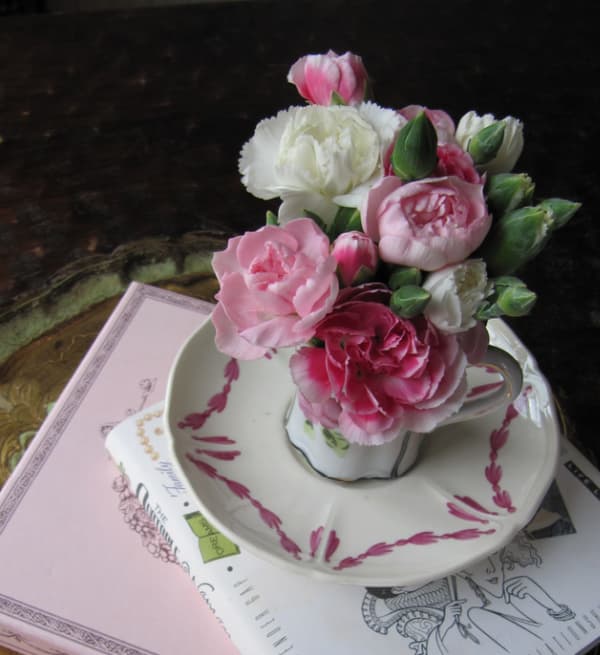
It looks small from the outside. It is the cup of drinking chocolate in a favorite cup, made for me, in the quiet, before anyone needs anything. It is the book left on my own nightstand instead of loaned away before I have read it. It is buying the peonies and putting them in the room where I will see them, rather than saving them for company that may or may not come. For most of my life I made the house ready for other people. I am learning to make it ready for myself.
If you want the longer version of how that practice actually works, day by day, I have written about it before. And I once wrote a letter to the woman who has been last on her own list for years, and the number of you who wrote back to say that is me told me everything I needed to know. But the practice is not really the point of this particular morning. The pivot is. The simple turning of the body to face a different direction.
The Book by the Bed
I will tell you the rest of the story, because it has a tender ending and I think about it often.
That was the last trip home where I did not feel like a guest. Something shifted in my mother after that conversation in the car. She never made a speech about it. She simply began to do the small things. The next time I came, my room was ready. There was a little book on the nightstand she thought I would like, and a card beside it. The things I liked were in the house. Nothing grand. Nothing over the top. Just the little things, the ones that say without saying it, I was thinking of you before you arrived. I wanted you to feel at home here. You, too, are someone worth making a fuss over.
She turned toward me. And it cost her almost nothing, and it meant almost everything.
I have carried that book and that card with me for years now, not the objects, the meaning of them. Because here is the question the whole thing leaves me with, and I will hand it to you the way it was handed to me. Who is setting the book by your bed?
For most of us the honest answer, for a very long time, has been no one. Not because we are unloved. Because we have been the ones doing the setting, for everyone else, and it never occurred to anyone, least of all ourselves, that we might need it too.
So that is what turning toward yourself means, in the end. It means becoming the woman who sets the little book by your own bed. Who fills your own glass. Who makes the house ready for the most important guest of all, the one who has been here the whole time, doing all the welcoming, and waiting, far too patiently, to be welcomed home.
I would love to know. Was there ever a moment you realized you had been the one making everyone else feel like a guest? And have you started, in your own quiet way, to turn back toward yourself? Tell me in the comments. I read every one, and I suspect more of us share this story than we know.
If this is the kind of thing you like to think about with a cup of something warm on a Sunday morning, come find me on Facebook, Instagram or X or Pinterest., where I share these small reflections all week long.
You Might Also Enjoy
Self Care After 50
Who Am I Now? How Midlife Didn’t Change Me, It Reminded Me
Putting Yourself Last After 50, It Is Time to Stop
The Power of Words, Even in Midlife


Hi Elizabeth, this really touched home for me. I’m 10 years older than you and finally realizing that it’s ok to do these things for Me. I don’t have children either, my passion is my animals. Throughout my younger years though all of the dinners and gatherings were at my house. I tried to make them as special as possible for each person that came. However, there was a time that someone jokingly commented about my use of cloth napkins instead of paper towels and my perfectly set table. That small comment started breaking my spirit. I realized all the hard work I put into making things special were not really appreciated. Eventually I stopped all together. Now I do things for me. If someone else enjoys it, that’s a bonus .
Thank you for your blog and your inner most thoughts.
Vicki, thank you for sharing your story. I am sorry that someone was heartless enough to break your spirit, even just a little bit. Especially after making their time at your home so special. I think it is wonderful that you continue to do these things…for yourself. Cloth napkins, a beautiful place setting and delicious food is always nice with friends but is just as special when created for ourselves.
We deserve to be treated the way that we treat others and if there is no one in your life that treats you that well then you should do it for yourself! It doesn’t have to be over the top but it should be special for you, your favorite coffee, dessert, a book, nice sheets, flowers, etc.
I am sure the animals in your life are treated like kings and queens and they appreciate it.
Have a lovely week.
Elizabeth, I can relate. I used to ask myself “When is it my turn?” I was like you, always making sure everyone else was taken care of. It took having cancer to teach me that I wasn’t ever going to get what I needed from my mother and certain friends. I let go of the one-sided relationships when I realized my worth. I love my mother, but I don’t have the same expectations. I love how your mother thought about what you said. She loves you and took action to show you how loved you are. You were brave to tell her how you felt. You are both blessed to have such a loving relationship. I am blessed with my daughter. We pamper each other when we can. She knows that I love and respect her and I know she loves and respects me. I am blessed.
Ellen, by nature I think we women take on this roll and then it seems as if it is expected. I am sorry that it took cancer for you to see it on your own life.
My mother is an amazing woman, and in her defense she was running a leather manufacturing company when that incident happened. Thankfully she listened and heard what I had to say. I am blessed to have her for a mother and a friend. How wonderful that you have your daughter to spoil and to be spoiled by.
I am sorry about your relationship with your mom, that has to be difficult.
Have a wonderful week and thank you for your always thoughtful comments.
Elizabeth
I think so many of us can relate to this. But…as you said we musn’t be martyrs. Many of us have brought this upon ourselves. We are up in the mountains this weekend with our son and daughter in law. They have entertained us for four solid days. Every meal has been delicious…we have seen the entire area. We have definitely felt pampered…
Cindy, how wonderful! A nice week away and time with your kids, even better to be pampered. I am sure that they are enjoying the trip as much as you are. Safe travels home.
I agree by the way, we do this to ourselves and then we get tired.
Have a wonderful week friend.
Hi Elizabeth: This was a very thought provoking essay. I grew up in a home where my mom thought of everything. All the touches that make people feel loved and important. During my working years as a designer I wore two hats. The designer hat and wanting everything to be as perfect as it could be, and the daughter filling very big shoes hat. I too wanted everyone to feel special when entering my home. But who was I really doing this for? After the loss of my mom I was able to take a breath if you will. Adjust certainly, but step back and see things a bit more clearly. Who did she do it for? Who did I do it for. I’ve come to the conclusion we did it for each other. We had a very special bond. She Got Me! I Got Her! We fed off each other. The joy in that is something I can never replace.
Recently I had my Quester’s group for brunch, and one of the members said “You know you don’t have to go to all this trouble”. My comment was I do this for me. I enjoy playing with my beautiful things that I have collected for a life time. This is a group of women that appreciates that effort, and it makes me feel good. Just before everyone comes I have a chance to step back, and there she is. Mom saying good job! That is priceless to me.
This is a subject that I have not explored but one that I need to thoughtfully address. I too am the person that is always thinking outwardly. How can I make everyone and every occasion special? And when I am ignored I feel slighted. But if no one knows that how can I blame them? I need to find my voice. Thank you for your thoughtful article.
Harriet, I hope that you take a moment or two to think about this topic. For so many women we just move through life as if this is our role and for some their efforts are not appreciated. Sadly they never speak up and become sad ro resentful. I hope that you speak up when you think you are taken advantage of or not appreciated! I think that you will find many will say that they did not know that is how you felt and they are sorry to make you feel that way.
Take care and have a wonderful week.
Just realized that with my old school friends that I am always the last one asked to join or many times never asked to join..they just talk about their trips even while I am there…I’m never the one they actually build a plan around…
Always the one to prepare the house for company with a special meaningful gift when we meet but never once has anyone thought to do the same for me.
I have and do make spaces in my home just for me to relax and enjoy. My husband is learning to listen and at times will see a need or want for me before I’ve asked and follow through with it. My son, 39 yrs old never gets me a gift or barely acknowledges my birthday, Christmas or Mother’s Day. I guess we just need to make sure our needs are med ourselves and don’t get weighed down by others. I don’t want to go through life feeling slighted. I think it’s just that they don’t see it as important. My mom was never a warm kind person. I don’t wish to follow in her shoes.